

“The Iron Veil” is a series of monthly essays about Immortal Game and the stories from chess history that shaped it.
Is classical chess1 dying? A question debated among top grandmasters and hobbyists on Reddit alike. Both groups, naturally, speak with equal authority on this topic.
When discussions about the future of chess arise, the standard argument is trotted out: Classical chess is not dying; it’s already dead. When players are motivated to maintain their rating rather than to win, they take no risks and games become drawish. The format cannot sustain the interest of the modern chess fan, whose attention spans have been eroded by social media and streamers. Online tournaments earn players more money. And perhaps the most intriguing: We live in a fallen world. There is no mystery to chess anymore. Grandmasters are no longer magicians on the board.
Chess engines like Stockfish can outplay even the strongest grandmasters. Anyone can boot up an engine and analyze a game. Anyone can tune into a live-streamed commentary and smugly watch the evaluation bar swing in one player’s favor or another. We can know, objectively, what the best move is in any position. Using an engine during a game is cheating, of course. But when players prepare memorized lines of 20+ moves ahead of time—when they play the best countermove against their opponent’s best move—doesn’t it all feel a little stale? Rote? Pointless? It’s said that chess played perfectly always results in a draw. It doesn’t get more dead than that.2
You might also hear that classical chess has lost its mystique and cultural capital because the best player in the world (and arguably the greatest to ever do it), Magnus Carlsen, has largely disengaged from the scene. Carlsen is the six-time World Chess Champion but declined to defend his title in 2022. He claimed he found no enjoyment in it anymore. Preparing for the WCC match is a brutal, basically never-ending grind—to say nothing of playing 14 day-long, high-pressure games. Besides, Carlsen has nothing left to prove. He seems to believe that his future—and the future of chess itself—lies elsewhere: blitz or bullet formats, where the players have only 1-5 minutes each; or freestyle chess, where the pieces are arranged in a random order on the first rank. This is how we keep the game alive: novelty, unpredictability, intuition.
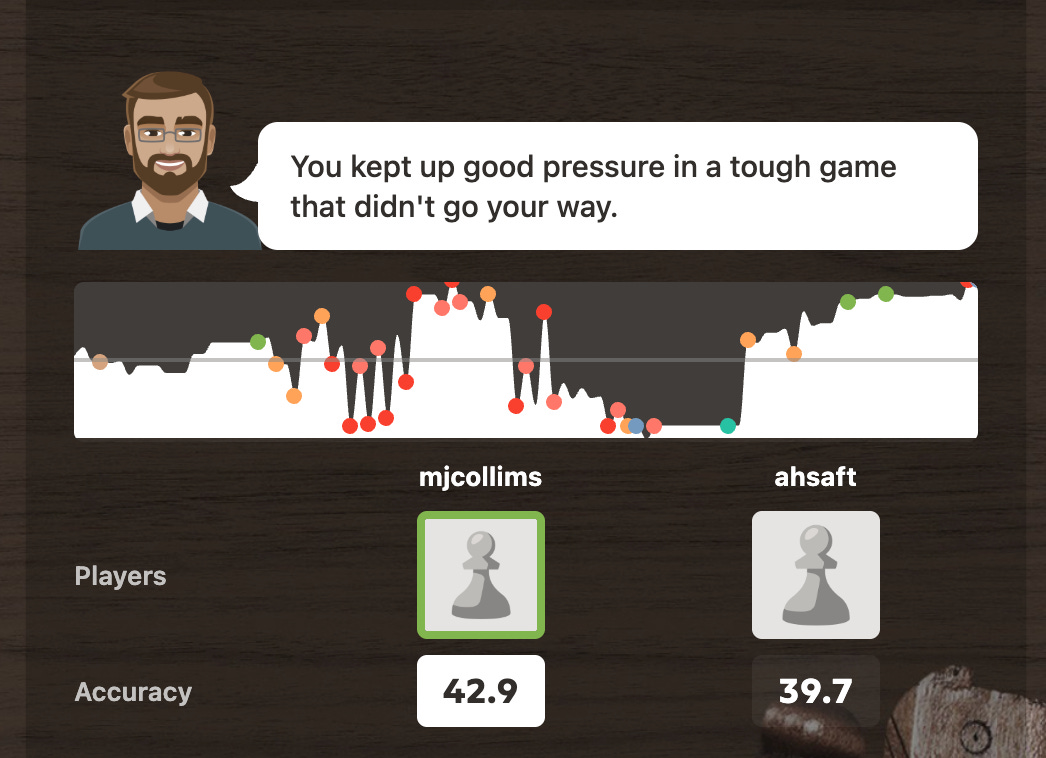
I love classical chess and don’t think it’s going anywhere anytime soon. Still, I find this debate interesting. I like that we’re reckoning with what chess ‘should’ be and how to keep its rapidly growing fanbase engaged. I like that we’re grappling with how the sport has changed over the years, because it’s changed a lot. Back in the day, players could not analyze their games with perfect objectivity. They didn’t know what the best move was. Coach David was not there to provide you a neat little summary and a graph that makes you feel bad. Stockfish was not recommending moves that are opaque to understanding and entirely impractical for a human being with real fears and emotions to play.
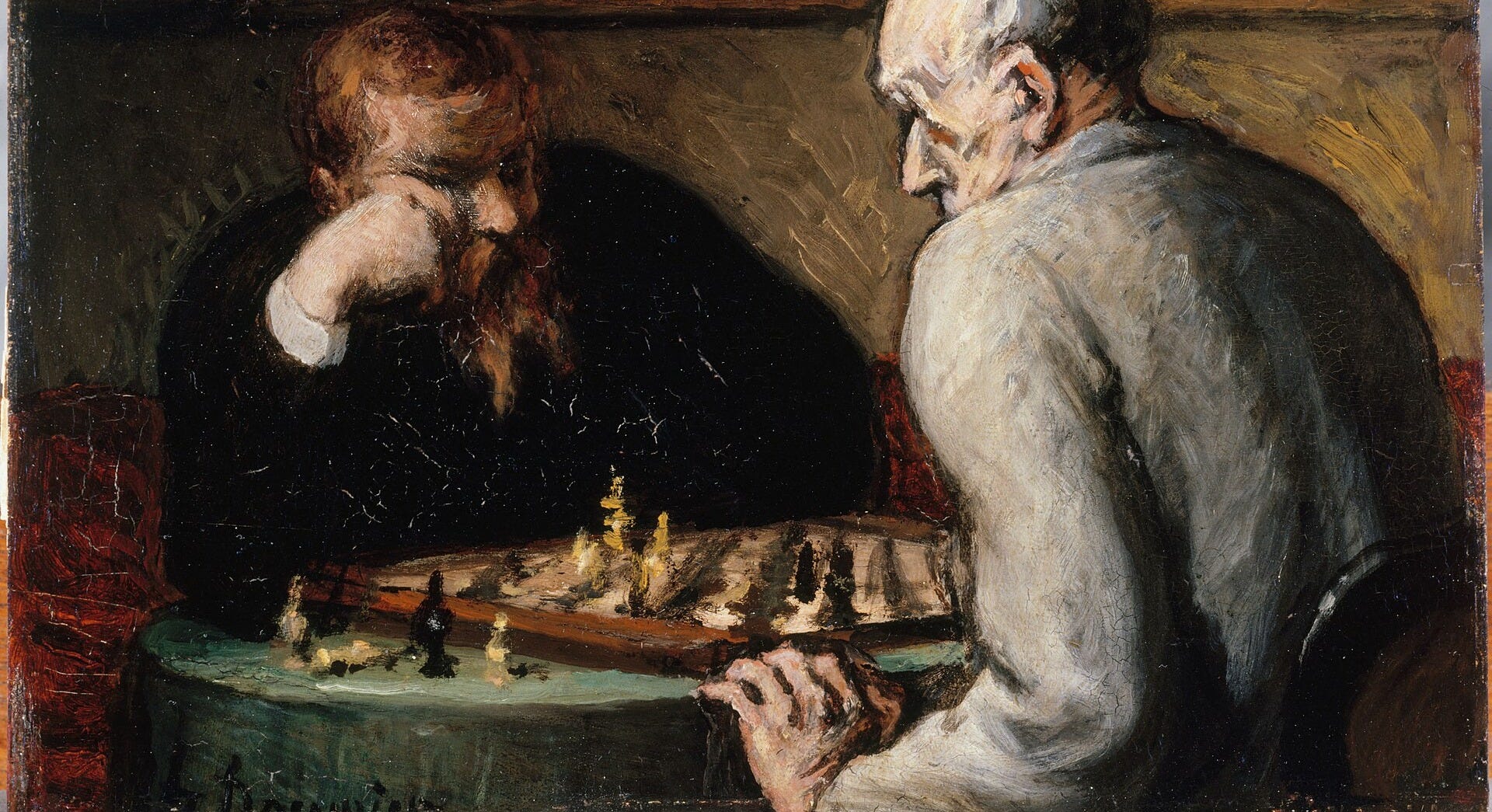
Chess engines have radically transformed the way we approach the game. Today, grandmasters play with almost perfect accuracy. But in the Romantic era of chess during the 18th and 19th centuries, grandmasters valued style above all else. They saw little point in winning if you couldn’t do it flashily. They played aggressive, risky gambits and frowned upon opponents who didn’t accept them. They sacrificed all their pieces in the pursuit of a beautiful checkmate. They were always on the attack, always at their opponent’s throat. They were swashbuckling and dramatic and bold!
The most famous game from the Romantic era is called The Immortal Game. It was played in 1851 by Adolf Anderssen and Lionel Kieseritzky. It’s a thrilling bloodbath of a game. Anderssen sacrifices several pawns, a bishop, both rooks, and his queen in order to deliver checkmate on the 23rd move. Modern-day engines are somewhat unimpressed, or at least unconvinced, by this game. Stockfish gives Anderssen an 80% accuracy score, and several of his sacrifices are marked as blunders or inaccuracies. Still, it’s one of the most studied and iconic games of all time. It certainly deserves to be called The Immortal Game.
Nowadays, people will use ‘immortal game’ colloquially. You can play your very own immortal game if you play in some spectacular fashion, or if you play the best game of your life. You’ll find posts on forums with subject lines like ‘I think I just played my immortal game.’ I chose the title for Immortal Game with this valence in mind. All the characters are hoping to play their own immortal game against the King of the Otherworld, who has never been defeated before. The title has the added benefit of evoking immortal fae and their cruel games, of which they are many in this book, both magical and sinister and petty and interpersonal. For me, it also brings to mind these discussions about the future of chess, as well as the vast difference between modern and Romantic styles. If you want to climb the rating ladder, even as an intermediate player, you can’t play like Anderssen anymore. Obviously, we can’t ever go back, and I don’t think we should. But have we lost something in our pursuit of perfection?
Shea Fury, the protagonist of Immortal Game, certainly has. When we meet her, she is nineteen years old and has dedicated the last six years of her life to preparing for one tournament, which is hosted by Midir, the King of the Otherworld every 100 years. She’s lost against Midir once before, and that loss cost her everything. Her single-minded focus on redemption and vengeance has killed her love for chess. She plays not to win, not to have fun, but to avoid losing. Partly to avoid jeopardizing her rating—mostly to avoid feeling so powerless and humiliated ever again. She no longer cares about artistry or the beauty of the game. She must be perfect. Anything less will lead to her destruction. This attitude underpins the tension between her and her love interest, Ciara of Bri Leith.
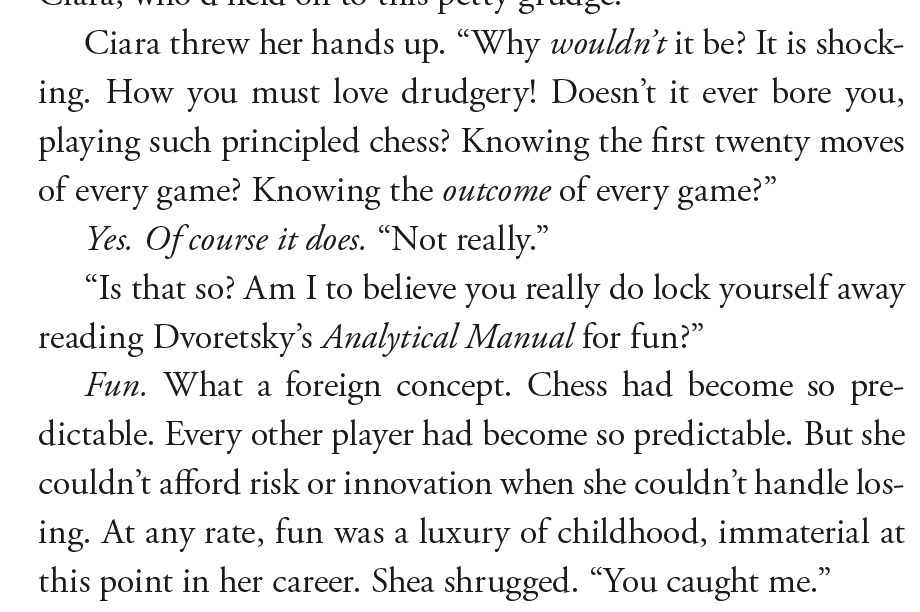
Ciara, whose early chess education focused on Romantic games, loves to play creatively. She loves sacrifices and unsound, offbeat openings. She loves taking her opponents ‘out of theory’ and into the deep, dark woods of a thorny, complicated position. In the Otherworld, the fae value the cultivation of single skill above all else. Ciara cannot fathom that Shea doesn’t delight in her talent. She cannot understand why Shea can’t play.
When I wrote Shea, I had Magnus Carlsen and his ennui in mind. I had Levy Rozman, who has shared how genuinely painful chess can be to play, in mind. I had myself in mind. We don’t have to be titled chess players to understand what it’s like to suck all the joy out of the things we love, or to come to hate something we believe we’d be nothing without. If there is one thing I have learned in my career, it is that perfectionism and fear lead to stagnation. They’re poisonous to passion and creativity. Immortal Game is about rediscovering the joy we’ve stolen from ourselves. Sometimes you have to play goofy, reckless, Romantic chess with a faerie princess to get it back.
about immortal game
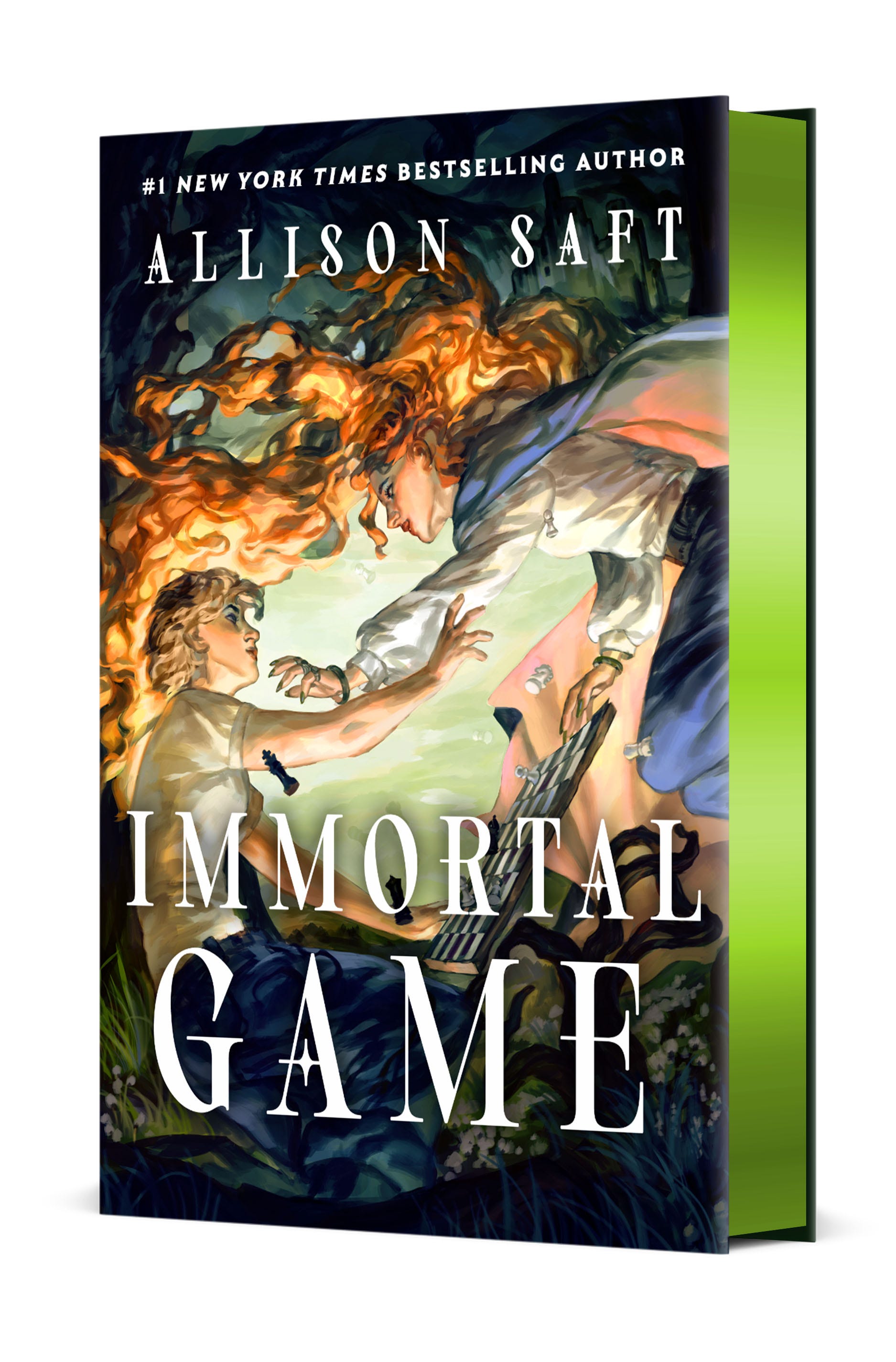
preorder: barnes & noble | waterstones | bookshop
The Queen’s Gambit x The Cruel Prince
Six years ago, Shea Fury’s sister was whisked away by the High King of the Otherworld, the ruler of the treacherous land of fae. Although Shea has spent the years since dreaming of rescuing her sister from captivity, the Iron Veil that separates the human world from that of the fae has made it only a wish. That is, until an invitation to participate in a once-in-a-lifetime chess tournament in the Otherworld arrives on Shea’s doorstep. The winner of the tournament may ask the High King to grant one wish, and Shea is finally within reach of hers.
But entering the tournament and winning it are two different matters. Dark magic lurks around every corner in the Otherworld, and Shea’s cutthroat opponents are willing to bend the rules to make their own wishes come true. To make it to the end—and to find her sister—she is forced to strike an alliance with her longtime rival, the sharply beautiful fae princess, Ciara of Bri Leith. One wrong move, though, and Shea could lose more than just the competition: She’d lose her sister, her dignity, and maybe even her life.
An over-the-board (in-person, rather than online) format where players have 90 minutes each to make the first 40 moves. The time control can vary, but these games often take all day.
Of course, it’s not so simple in practice. Classical chess can be and often is extremely exciting. Also: chess grandmasters are human! Sometimes they forget the best move in a given position. Sometimes, they’ll play an extremely offbeat opening to prevent their opponent from uncorking some 20-move line against a more common opening. Sometimes, they’ll take risks and play “sub-optimally” if it means they’ll catch their opponent off guard.
Still, elite chess players have frightening memories. They can recognize specific historic games by the arrangement of pieces on the board (say, the fifteenth move of the seventh game Karpov and Korchnoi played in the 1978 World Chess Championship). They seem to remember every game they’ve ever played and who it was played against and how they lost or won. I read somewhere that when people who learned to play very young look at a chess board, the area of the brain associated with recognizing faces lights up.